Gym software just entered its agent phase. Not the “we added a chatbot” phase — the phase where vendors ship workers that answer the phone, chase leads, book tours, nudge members, draft check-ins, and move capacity while your staff is still on the floor.
ABC Fitness’ recent push makes that hard to ignore: Replify-powered AI agents for prospect and member communications (voice, text, email, chat), plus FitMetrics-style AI assistance layered onto coaching workflows inside ABC Trainerize. The pitch is blunt and, in ops terms, fair: respond faster, automate the repetitive layer, let coaches carry more clients without a proportional headcount spike.
If you run a gym, studio, or coaching practice, that pitch will land. Admin already eats the relationship. Missed call-backs. Spreadsheet hell. “What did we do last week?” energy. The question is not whether agents belong in fitness software. They do. The question is whether you use them to buy capacity — or to quietly erase the human coach that members actually stay for.
This is an industry read from The Veteran Gamer, with an Iron System point of view: agents should clear ops and capacity so coaches stay personal — not become the product that replaces them. Iron System lives at ironsystem.fit; this essay is analysis, not an Iron System product page.
What “agent” means in gym SaaS (and what it does not)
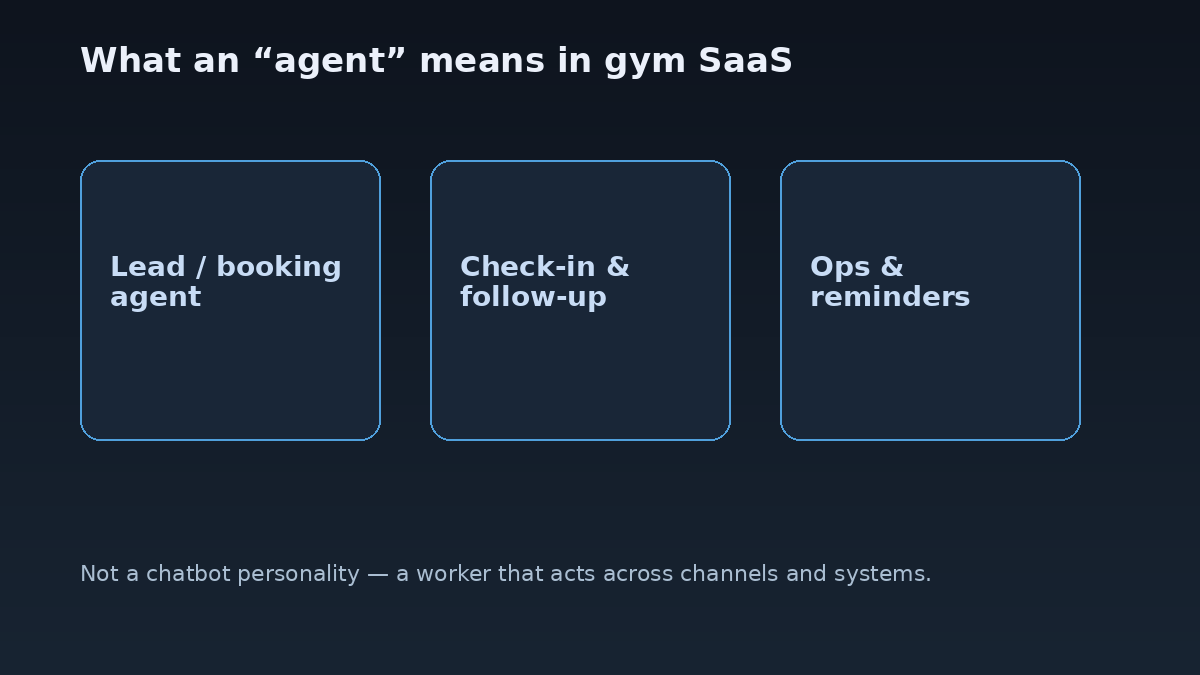
In gym SaaS right now, “agent” usually means software that can act across channels and systems with a goal — not a single chat box with a friendly name. Think: qualify a lead after hours, book a tour, follow up a missed call, remind someone about a check-in, summarize progress notes, draft a program tweak for a coach to approve.
That is different from a static autoresponder. An agent sits closer to a junior ops hire that never sleeps: it watches inboxes and calendars, applies rules and models, and pushes work forward until a human needs to take over.
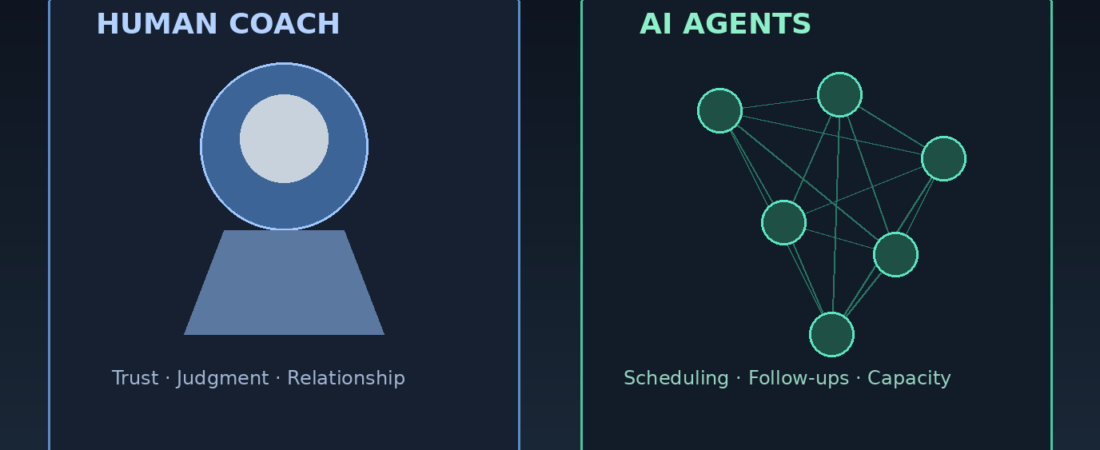
It is also different from a full coach. An agent does not own the relationship. It does not feel the room when an athlete is one bad week from quitting. It does not make the hard call that this squat pattern is wrong for this body today. If your vendor blurs those lines in marketing, keep your operational definition sharp: agents execute capacity work; coaches own judgment and trust.
Where AI actually helps: scheduling, follow-ups, capacity
The useful agent surface in fitness is boring in the best way.
Scheduling and front-door demand. Tours, intro sessions, class waitlists, no-show recovery. Speed matters here. A prospect who texts at 9:40 p.m. does not wait for your morning standup. Agents that capture, qualify, and book without inventing false intimacy are capacity, not replacement.
Follow-ups and continuity. Check-in prompts, “you missed Tuesday,” billing nudges, onboarding sequences. Most churn is not a dramatic breakup — it is silence plus friction. Automating the first mile of follow-up is how you protect coach time for the conversations that actually require a human.
Capacity math for coaches. Reviewing every check-in line-by-line does not scale. AI that drafts progress summaries, flags outliers, and prepares a short briefing for the coach is leverage. The coach still decides. The agent clears the queue.
Industry numbers will keep getting louder — 10x lead capture claims, big chunks of call volume automated, coaches supporting 2x–4x more clients with AI-assisted workflows. Treat those as directional, not gospel. The pattern underneath is real: ops automation and coaching assistance are converging inside the same gym OS stack.
If you already feel the squeeze — more members, same hours, same brain — agents are the honest answer to capacity. Spreadsheets are not a moat. Heroic overwork is not a product strategy.
Where humans still win: trust, programming judgment, the relationship
Members do not renew because your CRM replied in under thirty seconds. They renew because someone saw them.
Trust is built in awkward weeks: the deload nobody wants, the form correction that stings, the “I know you’re tired — we’re still doing the work.” An agent can schedule that conversation. It cannot be the person who earned the right to have it.
Programming judgment is not “generate a split.” It is knowing when the model’s tidy progression is wrong for a shoulder that has been whispering all month. It is choosing constraint over ego. AI can propose templates. A coach owns the veto and the why.
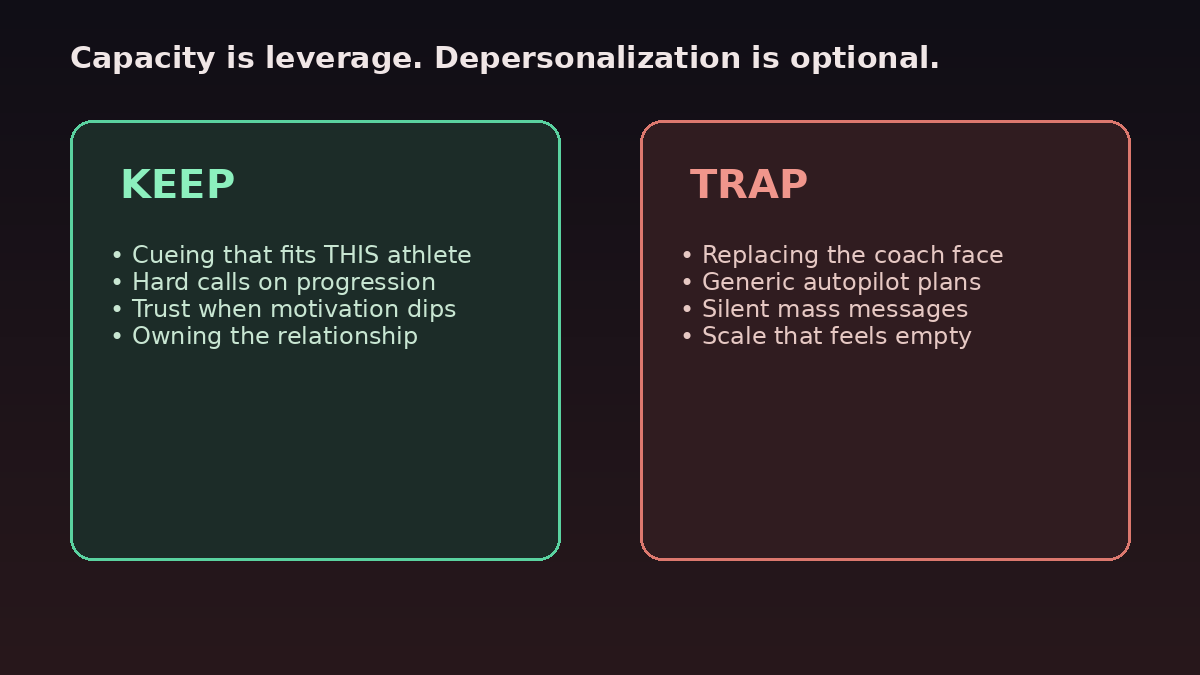
The member relationship is the product people actually feel. Cueing in the moment. Remembering the race date. Catching the mood before the set. That layer does not show up cleanly on a dashboard — and it is the first thing depersonalizing automation sandpapers away when you optimize only for throughput.
This is the soft contrast worth keeping on the wall: automation that removes busywork is respect. Automation that removes the coach’s face from the relationship is a different product — one that sells scale while leaking retention and reputation.
The depersonalization trap (and how operators avoid it)
Depersonalization rarely arrives as a villain monologue. It arrives as convenience:
- Mass messages that sound personal until the merge field fails.
- AI “coaching” that never names a human owner.
- Programs that update themselves while the coach becomes a silent brand on the invoice.
- Front-desk agents that close the sale with warmth the floor staff never get a chance to match.
None of that is inevitable. It is a design choice. Operators who stay sharp set a simple policy: agents may initiate and prepare; humans own commitments that change training, money, or trust. Disclose the stack when a message is automated. Keep a clear path to a person. Measure not only lead volume, but whether members still feel coached.
If your agent layer makes the gym feel like a call center with kettlebells, you did not buy capacity — you bought a different business.
Iron System’s stance: agents for capacity, coaches for the relationship
Iron System’s POV is deliberately unfashionable in a market racing to replace labor with chat: agents should buy coaches time; they should not replace the relationship.
That stance shows up in how the product is built as a fitness OS — training logs, plans/templates (including AI-assisted generation), diet tracking, body composition, and ranks/XP progression — with a free starting path and paid monthly templates for people who want the system to generate more of the plan load. The aesthetic is RPG-forward on purpose: progress should feel visible, not like homework. Professional coach and nutritionist workflows sit on the roadmap as structural work, not as an afterthought slogan.
What we will not pretend: Iron System is not claiming to be your after-hours sales call center. The bridge to the ABC FitMetrics / Replify-style wave is philosophical and operational: the industry is proving agents can carry capacity; the winning gyms will still need humans who own taste, trust, and programming judgment. Iron System is building toward that split — system capacity underneath, human coaching on top — rather than a chatbot that cosplays as your coach.
For athletes and coaches who want a system that respects that line, the door is open at ironsystem.fit — waitlist and product interest welcome. Tell us if you are a coach scaling a roster, or an athlete who wants the OS without losing the human in the loop.
Practical checklist if you are evaluating gym AI agents
- Name the jobs. Booking? Follow-up? Check-in triage? Draft programming? Different risk profiles.
- Require a human owner for plan changes, refunds, injury-adjacent decisions, and relationship recovery.
- Prefer draft-then-approve over silent send for anything that sounds like coaching advice.
- Audit the voice. If every message could have come from any gym in your city, you are burning brand equity for speed.
- Measure capacity and care. Hours returned to coaches and whether members still feel known.
Agent fleets in fitness are not coming. They are here. The operators who win will treat them like junior staff with a narrow charter — not like a replacement for the coach whose name is on the relationship.
Capacity scales. Trust does not autopilot. If that framing matches how you want to build, look at Iron System — and keep the human coach in the loop on purpose.