
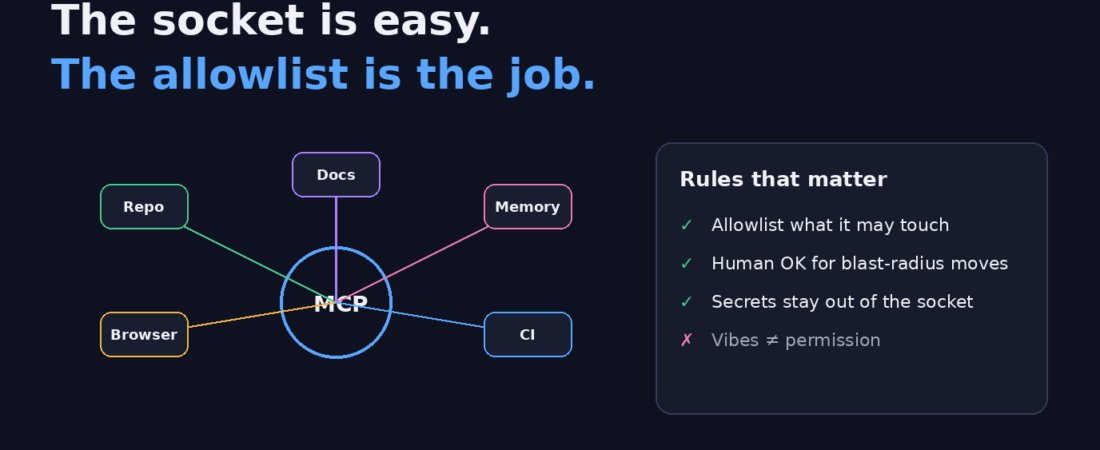
If you already use agents every day, MCP is not a future headline. It is the socket under your workflow: the way a model reaches the browser, the repo, the docs, memory, CI, and whatever else you allow. Cursor users live this. Claude Code users live this. The protocol name will change. The pattern will not — agents that can only autocomplete stay cute; agents that can touch real systems become useful, and useful has blast radius.
This is the short companion to our longer take on agent fleets — Agent Fleets Are Here — Claude Code, Cursor MCPs, and What Still Has to Be Yours. Fleets multiply hands. MCP wires the tools. Governance is the boring layer that decides whether that speed compounds trust or compounds mess. Plain English. No horror stories. Just operating rules for people who already plug agents in.
MCP in one sentence
Model Context Protocol is a shared way for an agent client to call tools you expose — instead of every chat app inventing a private plugin dialect. Think USB for agent capability: one shape of connector, many devices. You (or your stack) decide which devices are on the desk.
That is the whole magic trick. Not “AI got smarter.” Infrastructure culture catching up so tools attach cleanly. The socket is leverage. The socket is not a moat. Everyone who ships agent workflows will use some socket. Your edge is whether you can answer, without squirming: what can it touch, what needs my OK, and what never leaves this machine.
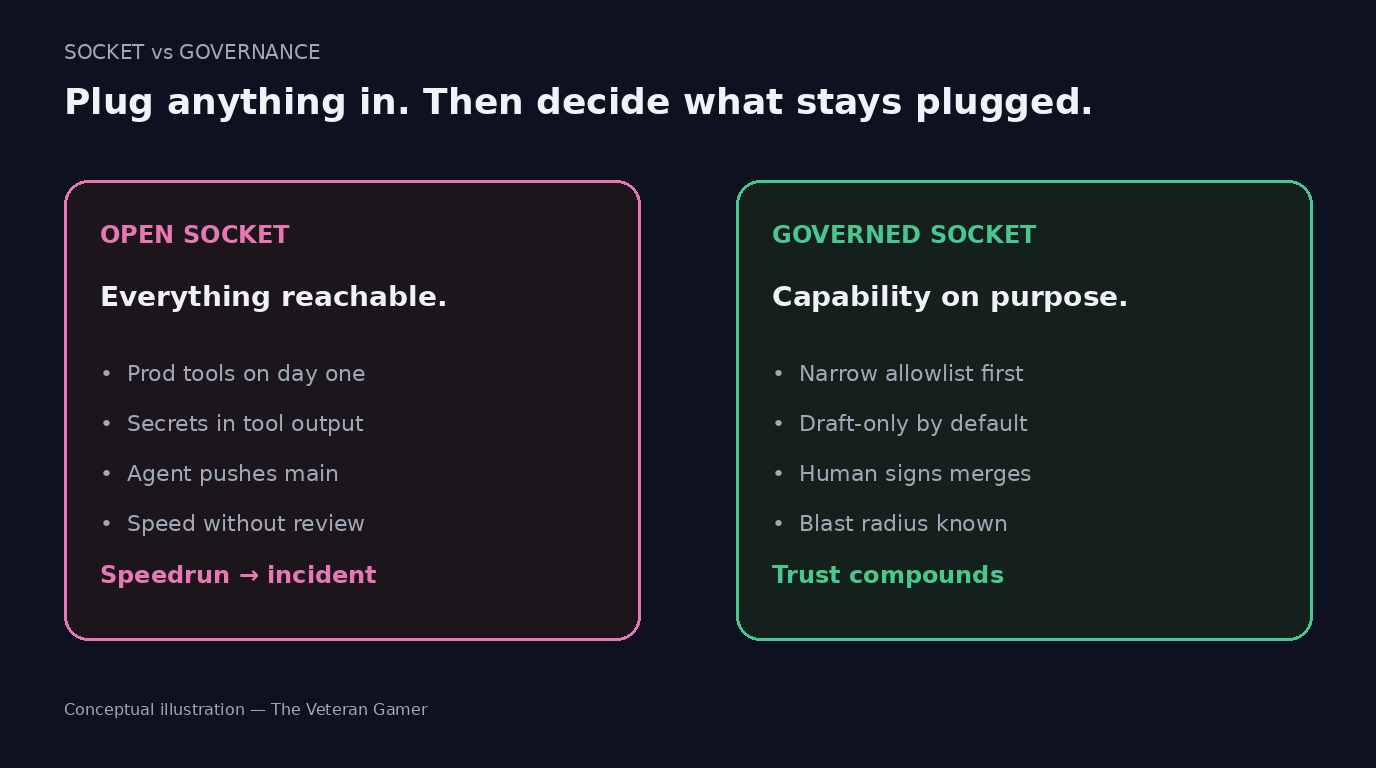
Why governance matters if you use agents daily
Daily use is the risk multiplier. A weekend demo with read-only docs is not the same as Tuesday afternoon with repo write, a browser session, and a half-remembered production MCP still enabled from last month’s experiment.
Governance is not bureaucracy theater. It is three practical questions you answer before the agent is helpful enough to surprise you:
- Scope — Which tools are allowed right now? Prefer an allowlist over “everything the IDE can see.”
- Authority — Which actions stay draft-only until a human signs? Merges, deploys, public posts, anything with irreversible blast radius.
- Boundary — What never enters the socket? Secrets, production credentials, customer data you would not paste into a random chat.
If those answers live only in your head, they evaporate under deadline pressure. Write them once. Short. Sticky. Revisit when you add a new MCP server — same way you would revisit permissions when you hire a contractor.
A boring mental model that works
- Socket — how tools attach (MCP and whatever follows it).
- Fleet — how work parallelizes (coordinators, threads, subagents).
- Governance — what may run, what stays draft, what never leaves, what needs a human OK.
Keep those three words separate and you stop confusing “we use MCP” with “we are safe.” Glue is not judgment. Parallelism is not taste. Speed is not permission.
Practical rules that survive a busy week
Start narrow. Repo read, tests, local docs. Widen only when you understand the blast radius. Production-adjacent tools are a junior-with-root situation — possible, rarely wise on day one.
Default to draft. Let the agent propose. You merge. Let it draft the PR description. You publish. The ritual is the point: a cold read before anything that carries your name.
Keep secrets out of the socket. Not in prompts, not in tool outputs you did not audit, not in “temporary” env dumps the agent helpfully summarized. If the agent needs a token, use the smallest scoped credential and rotate like you mean it.
Name the human. When something weird ships, the ticket is not against Thread B. It is against you — or your brand. Governance is how you stay able to explain the change without blaming the protocol.
Disclose when you build in public. A one-liner — “agent drafted, I edited and signed” — ages better than opaque AI. Same moat we argued in the fleets piece: honesty compounds; vibes do not.
What this is not
This is not a call to unplug. Agents that can reach real tools are why solo builders suddenly feel like a crew. It is also not fearmongering about rogue models. Most of the damage you will see looks ordinary: over-permissioned tools, rushed merges, secrets that should never have been in context, and “I thought it was sandboxed.”
Governance is the adult version of excitement. Plug the socket. Then build the rules.
The Veteran Gamer take
MCP governance in plain English: capability on purpose. If you use agents daily, your competitive advantage is not collecting connectors — it is knowing which ones are live, which actions require your signature, and which data never crosses the wire. Pair this with the fleets companion above when you want the longer arc. For builders who think in public, the same stance shows up on YouTube at @veterangamer217 — socket sharp, signature sharper.