I’ll grind XP in a game for hours without a single complaint. The gym I’ve quit about four times. That bothered me for years until I understood the problem was never laziness — it’s the feedback loop.
An RPG pays you back in seconds: killed the thing, got the XP, bar filled, number went up. The gym pays you back in three months, and only if you took photos to compare. No game designer would ship a loop like that and expect retention. But that’s exactly what we accept when we start training.
The good news is that plenty of people are trying to fix it. Here are six apps that put game mechanics on top of training — each one solving a different piece of the problem.
Disclosure, before any comparison: the sixth app on this list, Iron System, is built by me, the author of this blog. I have no relationship with the other five — no affiliate link, no sponsorship. Read the list knowing that.
The comparison, in one table
Facts before prose. Prices checked on official stores and pages on September 14, 2026, in the currency each one bills in — they change and vary by region.
| App | Price | Works for lifting | Builds the workout | Diet / macros | Uses body composition | Multiplayer | Needs hardware |
|---|---|---|---|---|---|---|---|
| Zombies, Run! | Free + $6.99/mo or $49.99/yr | No (running) | Running plans | No | No | No | Headphones |
| Habitica | Free + $4.99/mo or $47.99/yr | Only as a checkbox | No | No | No | Parties and guilds | No |
| Ring Fit Adventure | $79.99 — one-time | No (Ring-Con) | The game decides | No | No | No | Switch + Ring-Con |
| Zwift | $19.99/mo or $199.99/yr | No (bike / run) | Structured plans | No | No | Yes, live | Trainer + bike |
| Workout Quest | Free + $2.99/mo or $29.99/yr | Yes | Yes, AI | Yes | No | Party, guild, raid | No |
| Iron System | Free + R$ 19.90/mo | Yes | Yes, AI | Yes (TACO table) | Yes — it gates rank | No | No |
No verdict column, on purpose. The table answers “does this exist or not”; which column matters depends on where your training stalls.
1. Zombies, Run! — the veteran
The oldest and still the best at what it does. Headphones on, start running, and the app narrates a post-apocalyptic story where you’re Runner 5 scavenging supplies for a base. When the audio warns that zombies are on your tail, you speed up — not because the app told you to, but because the story pushed you.
Over 500 missions and 10 million users, which in a niche like this is MMO-sized. Works walking, running, or on a treadmill.
For: runners who get bored alone. Weak spot: running only. If you lift, it does nothing for you.
2. Habitica — the habit RPG
Habitica is literally a 16-bit RPG where your real-life tasks are the quests. You get an avatar, HP, MP, gear, and a party that takes damage when you miss a task. That last part is the trick: the social pressure of not draining your friends’ HP works better than any notification.
For: people who need general discipline, not just training. Weak spot: it gamifies the habit, not the workout. “Went to the gym” is a checkbox — it neither knows nor cares whether you did 3 sets or 30.
3. Ring Fit Adventure — the one that isn’t an app
Cheating on this list, since it’s a Switch game and not a phone app, but leaving it out would be dishonest. The Ring-Con reads the force you apply and turns a squat into an attack in a turn-based RPG with a map, bosses, and a skill tree. It’s the only one here where the exercise is the combat mechanic, not a metric feeding one.
For: starting from zero without setting foot in a gym. Weak spot: low ceiling. At some point the accessory can’t overload you anymore. It’s also the only one you buy once instead of subscribing — $79.99 with the accessories in the box.
4. Zwift — the cycling MMO
You put your bike on a smart trainer and ride inside a 3D world alongside thousands of people pedalling live. There are races with a start line and standings, group rides, and aerodynamic drafting — sit in someone’s slipstream and you genuinely spend less energy.
It’s the closest thing fitness has to a real MMO: the multiplayer isn’t decoration, it’s the mechanic.
For: cyclists. Weak spot: needs a trainer and a bike. It’s the most expensive on the list by a wide margin — $19.99/month before hardware.
5. Workout Quest — the lifting RPG
This one goes after what the others ignore: the weight room. Each muscle group has its own level, you earn XP by logging sets, and you unlock loot and achievements by training. “My chest is level 12, my legs are level 4” is absurdly effective — the imbalance becomes something visible that nags at you.
And it’s more complete than the name suggests: an AI coach that builds and adjusts the program, macro tracking, and a real social layer — parties, guilds, and raid-boss workouts. Of the first five, it’s the one that overlaps most with the sixth.
For: people already lifting who want a game layer with other people in it. Weak spot: the XP is born from what you typed. Nothing in it checks whether the body actually changed.
6. Iron System — XP backed by something
Look at the pattern in the first five: each solves one piece. Zombies, Run! solves boredom. Habitica solves discipline. Ring Fit solves starting. Zwift solves the social part. Workout Quest solves the lifting scoreboard. None of them, though, solves the underlying problem — and the underlying problem is that the XP is worth nothing.
That’s the structural hole in workout gamification: when XP comes from what you declared, it becomes currency with no reserve behind it. Tick “went to the gym” and you score the same as someone who trained hard. Eventually the brain notices the fraud and the number stops meaning anything.
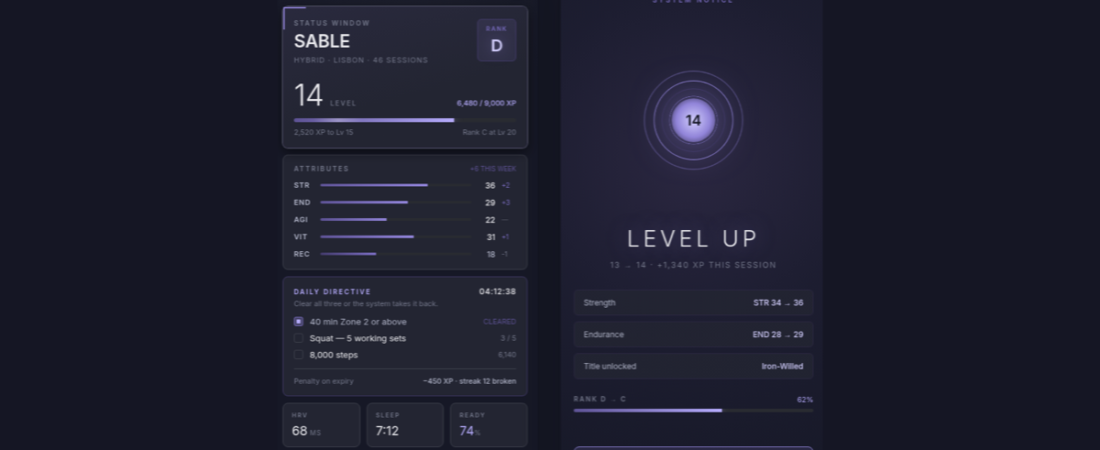
Iron System goes at that gap. It’s a training system in the Solo Leveling mold: instead of a generic “level”, there’s a rank — E, D, C, B, A, S, S+ — computed from XP accumulated across your entire history, not this week’s.
What it does that none of the other five do:
- Rank is capped without measurement. With no body composition data, rank stops at D no matter how much XP you pile up — and every session’s XP is scaled to 60% until you verify. Real progress requires real measurement. It’s the one column in the table above with a single “yes” in it.
- Attributes are derived, not assigned. STR, VIT, END, AGI and REC come out of what you logged — weight, sets, reps, PRs, duration. There are no points to allocate: squat heavy and strength goes up. With diminishing returns, so 90 to 91 costs far more than 10 to 11.
- Diet on Brazilian data. The diet generator runs on the TACO food composition table, not a mangled conversion of American food data.
- It covers the whole day. Photo-based meal logging and water intake also earn XP. Training is one hour; the other 23 decide the result.
- It filters the workout by your limitations. If your profile says scoliosis, disc herniation, shoulder, knee, or wrist, the contraindicated exercises leave the catalog before the generator picks anything — someone with scoliosis doesn’t get a barbell back squat. Not medical advice; a comfort filter built from what you wrote.
And what it lacks that others here have: no multiplayer at all. No party, no guild, no leaderboard among friends. Habitica, Zwift and Workout Quest win that point today, no argument.
It opened to the public in early September 2026 — closed beta until then. It’s in Portuguese and English. Workout logging, XP, ranks, body composition and water are free; what costs R$ 19.90 a month (billed in Brazilian reais) is generating routines and diets and logging meals.
One category difference worth stating: the other five are mature products, some with over ten years behind them, and they change little year to year. Iron System is under active development, with changes landing every week — in the week I wrote this post alone it got the limitations filter, biset and triset XP, a penalty for skipped exercises, and autosave for a workout in progress. That cuts both ways: it’s the newest and the least battle-tested on the list.
For a sense of direction, with no date promised: what’s on the table is an annual plan, the gym as a real guild — with rankings between gyms and between members of the same one — and account types for trainers and dietitians, linked to their clients. None of it is built. It’s where the system is looking.
So which one
Depends on where your training stalls. Boredom on runs, Zombies, Run!. General discipline and not just training, Habitica. Starting from zero without facing a gym, Ring Fit. Cycling, Zwift, no argument. Lifting with other people around, Workout Quest — and it’s cheaper.
But if the problem is the most common one of all — training for months, seeing no progress, and having no idea where you actually stand — no app that only counts attendance will fix it, because attendance isn’t progress. That question is why I built the sixth one.
And the point that outlives any app on this list: the reward loop is a technology. The games industry spent 40 years perfecting it to make you come back tomorrow. There’s no reason at all for it to stay locked inside a video game.
Transparency note: Iron System is built by the author of this blog. None of the other five apps sponsored or reviewed this piece. Prices checked on 2026-09-14 on official pages and stores; Iron System bills in Brazilian reais, the others in US dollars.