
Gamers soft-reset characters for fun. Gym people soft-reset programs for anxiety. New spreadsheet on Monday. New app by Thursday. A “fresh start” that quietly deletes every PR, streak, and hard-won habit you already paid for in sleep and DOMS.
If that loop sounds familiar, the problem is not motivation. It is season design. Ranked players already know how to finish a climb: pick a patch, lock a role, ride the swings, take the scheduled break. Training needs the same architecture — a block you can close — not another character select screen.
This piece is about building an 8–12 week training season you will actually finish, why deload weeks are patch notes (not failure), and how one progression loop beats a pile of half-used fitness apps. If you want the product-shaped version of that loop, Iron System is the Fitness OS we built around training, diet, body metrics, and ranks in one place.
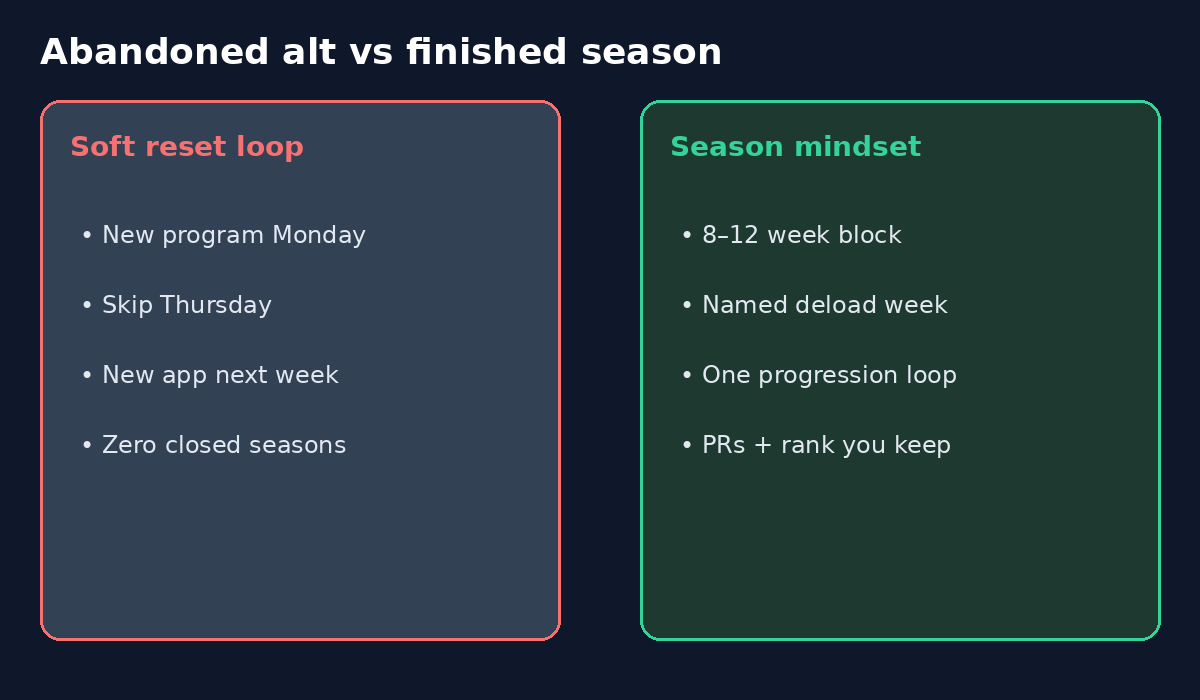
Why soft resets feel productive (and stall you)
A soft reset scratches the same itch as rerolling an alt: novelty, clean UI, the illusion of a better plan. For a week it works. Then life hits — a late raid night, travel, a bad sleep stretch — and the new stack has no memory of what you already proved you can do.
Fragmented tools make the reset cheaper. Workout app A does not talk to macro app B. Body weight lives in a notes file. Rank or streak lives in your head. When friction spikes, you do not troubleshoot the season — you abandon the character.
Veterans do the opposite in competitive games. They do not scrap the account after one bad night. They review the VOD, adjust the role, and stay on the climb. Your gym log deserves the same respect.
Define the season before you touch the weights
Write four constraints on a sticky note — or in the first session of your log. Keep them boring.
- Length — 8 or 12 weeks. Not “until I look different.” Seasons have end dates.
- Main quest — one primary outcome. Strength on a lift family, work capacity, or composition change. Side quests are optional accessories, not competing mains.
- Session budget — days and minutes you can defend on a bad week. Design for the bad week.
- Deload week — named in advance. Week 5 of 8, or week 7/11 of 12. If it is not on the calendar, you will invent a panic reset instead.
That is enough to stop the Monday roulette. You are no longer shopping for vibes. You are executing a season.
Progression is the XP bar — protect it
Progressive overload does not require heroics. It requires a visible scoreboard: load, reps, RPE, or total weekly tonnage. Pick one primary metric per lift and nudge it when recovery allows. When recovery does not allow, hold or drop — that is still season play, not a soft reset.
Personal records matter because they survive mood. A PR from week 3 still exists in week 9 when motivation is flat. Ranks and XP — the language Iron System uses from E toward S+ — are just a readable skin on that truth: advancement should compound, not evaporate every time you open a new app.
If your current stack cannot show last month’s sessions next to this week’s, you are flying without a minimap. Fix the log before you fix the program.
Deload weeks are patch notes
In games, patch weeks lower intensity so the meta can settle. In training, a deliberate deload lowers volume or load so joints, sleep, and enthusiasm catch up. Skipping deloads is how “grindset” turns into three weeks off with a sore elbow and a new program PDF.
Name the week. Cut volume ~40–60% or drop intensity and keep movement patterns. Keep showing up lightly if that protects the habit. Then resume the same season — same plan ID, same log, same rank track. That continuity is the whole point.
A deload is not a soft reset. A soft reset throws away the save file. A deload writes a checkpoint.
One loop beats five side quests
We already covered why app stacks fail in Iron System: Training, Diet, and Ranks Without the App Stack — and why gamified workout apps leave the progression half-finished in 6 Apps That Turn Working Out Into a Game. The short version: you become the integration layer. Integration layers quit.
A finished season wants one place where session completion, diet adherence, body markers, and rank feedback sit in the same narrative. That is the product bet behind ironsystem.fit: free core loop for logging and progression, paid monthly templates when you want a fresh model without abandoning the account. Use it, or build an equivalent single log — but stop pretending five tabs are a system.
Coaches still matter for the human layer. Agents and templates buy capacity; they do not replace judgment. We argued that split in AI Coaches That Scale Capacity — Without Erasing the Human Coach. Season design is how you use that capacity without soft-resetting every time a shiny plan drops.
A practical week-one checklist
- Lock the 8–12 week end date on a calendar you actually see.
- Choose one main quest metric and write it at the top of the log.
- Schedule the deload week now — treat it like a ranked maintenance patch.
- Put workouts, food, and body notes in one system (Iron System or your own single source of truth).
- Ban “new program Mondays” until the season ends — adjustments yes, character selects no.
The Veteran Gamer take
Soft resets feel like agency. Seasons create agency that compounds. If you already understand ranked climbs, patch notes, and not deleting an account after one loss streak, you already have the mental model — apply it to the gym. Build a season you can finish. Keep the save file. And if you want that loop with ranks attached out of the box, start at Iron System.
Keep reading