
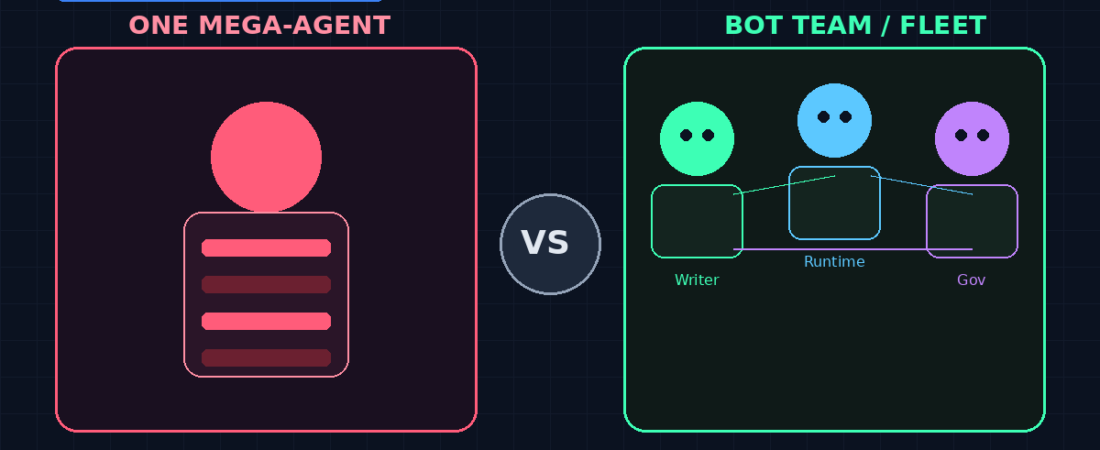
Google just open-sourced the quiet admission the agent ecosystem has been dancing around for a year: one mega-agent is a cute demo; a fleet is how you ship. AX — Agent Executor — is Apache 2.0 on github.com/google/ax, with docs at agentexecutor.io. Call it Google’s open agentic orchestrator: a Kubernetes-shaped runtime for autonomous AI agent workloads, built on Agent Substrate, that treats agents as stateful actors you can suspend and resume — not as microservices you keep hot forever.
If you have been living inside Claude Code, Cursor, and MCP sockets, this is not “another framework.” It is infrastructure culture catching up to how veterans already run work: specialized roles, isolation, governed egress, and a save file you can pause. We mapped the human side of fleets in Agent Fleets Are Here. AX is the cluster-shaped version of that same idea.
Why agents are not microservices
Microservices are mostly stateless. Batch jobs run to completion. Agents do neither. They accumulate workspace state, burn tokens in loops, call model APIs and tool servers, wait on humans, and can set money on fire if nobody fences the network. Keep them as always-on pods and you pay for idle thinking. Treat them as fire-and-forget scripts and you lose the checkpoint when the model call hangs.
AX’s bet is blunt: agents are a new workload class. The runtime should look familiar if you know Kubernetes — declarative YAML, apply, watch, describe — but the verbs matter. Suspend. Resume. SSH into a sandbox. Checkpoint actor state instead of hoping Redis remembers your chat transcript.
Four primitives, not a thousand plugins
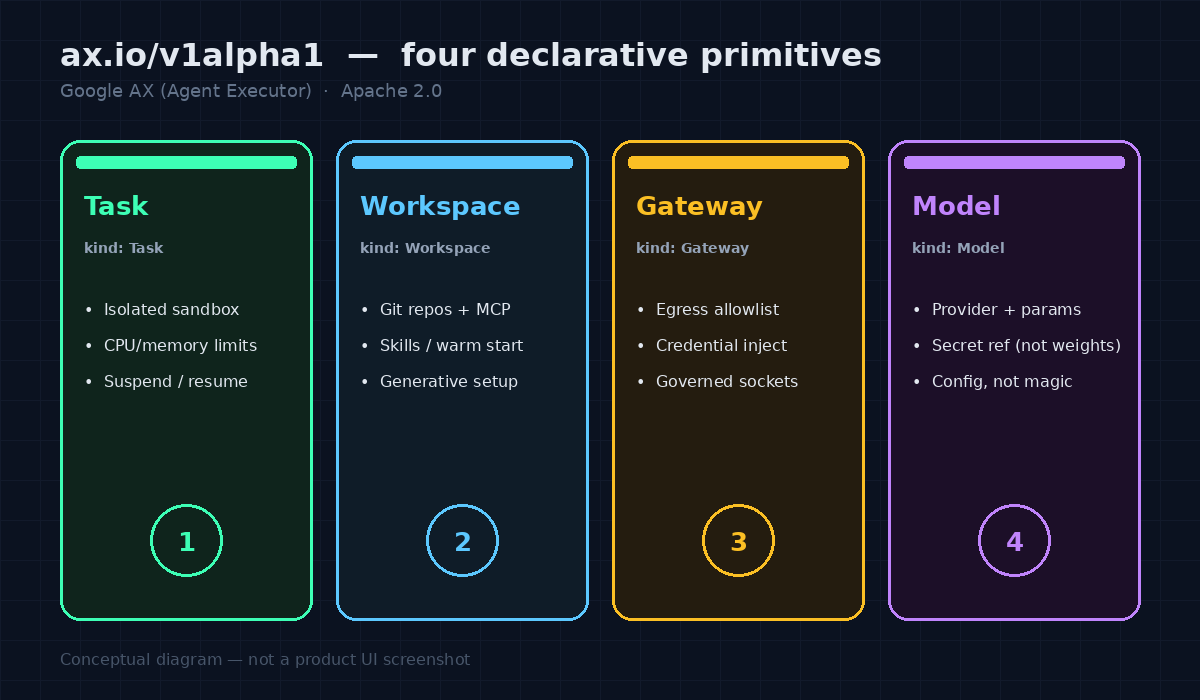
Everything lands under ax.io/v1alpha1. Four kinds do the heavy lifting:
- Task — isolated, sandboxed execution with CPU/memory limits. Cheap to create, suspend, and throw away. This is the unit of work, not “the agent personality.”
- Workspace — Git repos, MCP servers, and skills pre-wired so every agent starts warm. You can also hand it a plain-English goal and let a generative workspace set up the toolchain before the task boots.
- Gateway — egress allowlist plus credential injection. The boring, essential socket: what hosts can this actor touch, and with which secrets?
- Model — provider, model id, params, and a secret ref. Config for the platform’s LLM — not “the weights,” not a magic brain in a box. Rotate a key or pin a version with one apply.
That split is the whole story. Specialization beats a monolith that tries to be editor, browser, deploy pipeline, and compliance officer in one prompt. Isolation beats “trust me, the agent is careful.” Governed sockets beat open internet by default. Suspend/resume beats keeping a thousand idle sandboxes warm because you might need them later.
Early-stage means early-stage
AX is preview. Google’s own docs warn that interfaces and protocols may change before a stable release. It is not a finished production safety story by itself — Gateway helps, Substrate isolation helps, but you still own threat models, tenant boundaries, and what “resume after failure” means for your money-moving tools.
Read that the way a ranked player reads patch notes: useful direction, not a warranty. Pin a revision. Test interrupt and resume. Prove the egress allowlist actually blocks what you think it blocks. Then decide whether your fleet belongs on this control plane or on something narrower.
Why a bot team beats one mega-agent
The mega-agent fantasy is one chat window that does research, writes code, deploys, posts, and apologizes. It fails for the same reasons a one-hero raid fails: blast radius, context rot, and no clean ownership when something breaks.
A bot team — writer, researcher, QA, social, ops — matches how real work already splits. AX’s primitives make that split honest at the infrastructure layer:
- Specialization — different Workspaces and Models per role instead of one overloaded system prompt.
- Isolation — Tasks that cannot casually read each other’s sandboxes.
- Lifecycle — suspend idle actors; resume when the human or the model answers.
- Governed sockets — Gateways that make “what can this bot touch?” a YAML review, not a vibe.
That is also how we run The Veteran Gamer’s non-coding roster in practice: writers, editors, social, QA — each with a lane — instead of one mega-bot that “does content.” The company model is multi-agent on purpose. AX is Google saying the cluster should admit the same truth.
How this fits MCP (without replacing it)
MCP is the USB port. AX is closer to the rack and the network policy. Workspaces can pre-wire MCP servers into sandboxes; Gateways decide which hosts those tools may call. If you already care about MCP governance — what tools are attached, who can enable them, how secrets move — read our plain-English companion: MCP Governance in Plain English. Protocol hygiene and runtime isolation are complementary. Neither replaces judgment.
Same rule we keep repeating for coaches and agents: capacity scales; ownership does not evaporate. Tools buy hands. You still own the season design — see also AI Coaches That Scale Capacity Without Erasing the Human Coach.
What to do with this (practical, not hype)
- Skim agentexecutor.io and the Concepts doc on GitHub before you clone anything into prod.
- If you already run agent fleets in Cursor/Claude Code, map your roles onto Task + Workspace + Gateway mentally — even if you never install AX.
- Treat Model as config. Keys in secrets. Versions pinned. No “the agent knows the API key because it lives in the prompt.”
- Expect breaking changes. Preview means you are a design partner, not a customer of a finished SLA.
The Veteran Gamer take
Infrastructure finally said out loud what gamers and ops people already know: fleets beat lone heroes when the fight is long, stateful, and expensive. AX will evolve. The primitives — sandbox, workspace, gateway, model config — are the part worth stealing even if you never touch the binary. Build bot teams with lanes. Fence the sockets. Keep a save file you can resume. And if you want the longer content trail on how we think about agents in the wild, the YouTube lane stays at @veterangamer217.
Keep reading