
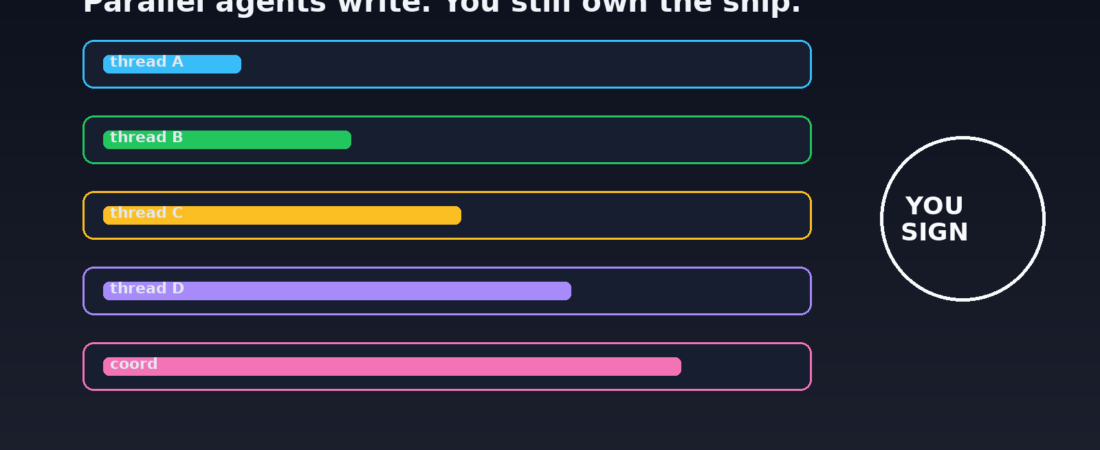
On September 17, 2026, Anthropic relaunched Claude Code Projects around a blunt idea: one project conversation, a coordinator, and parallel cloud threads that each behave like a full Claude Code session on their own branch. Shared memory. Shared library. Merge conflicts when threads step on the same code — same as any other PR. That is not a demo slide. That is agent fleets as a product surface.
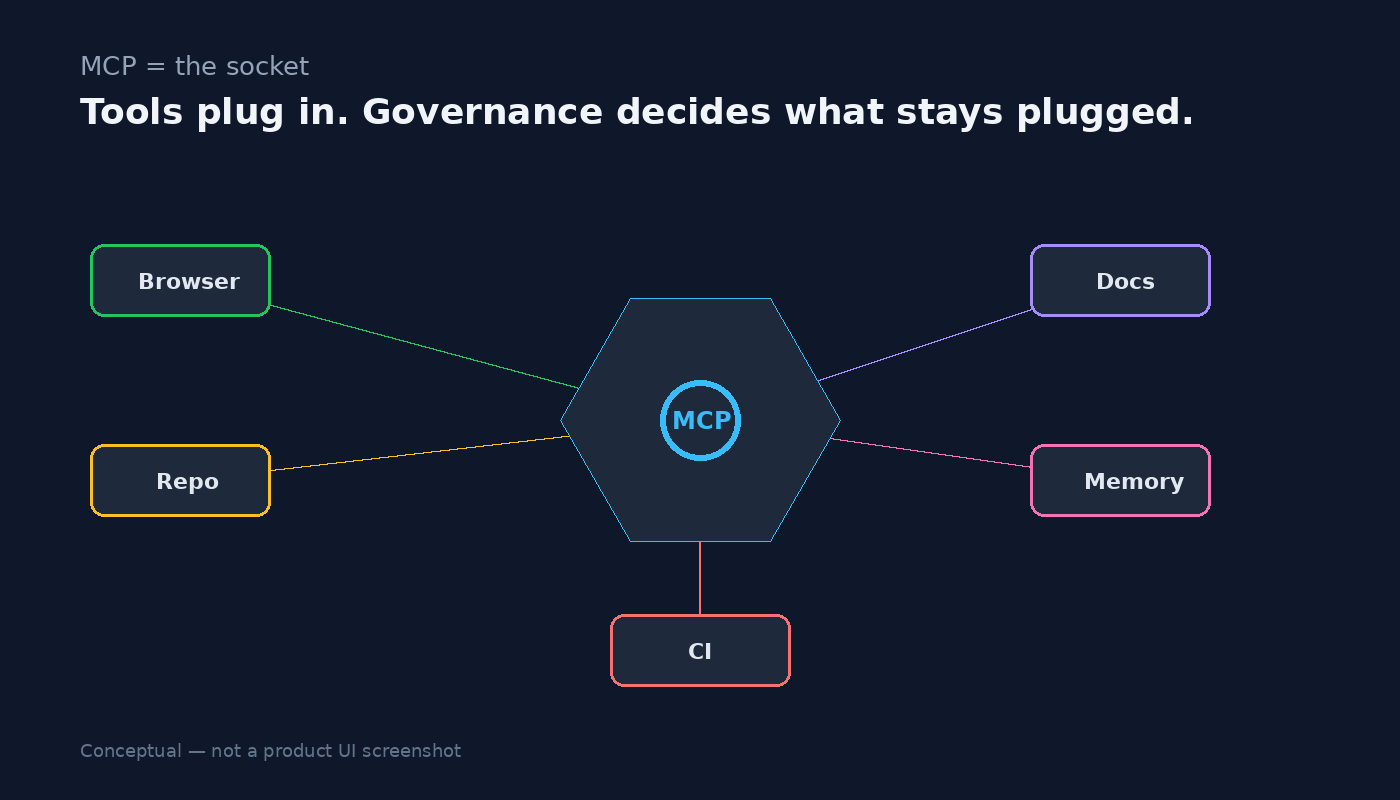
Cursor users already know the other half of the stack: MCP (Model Context Protocol) as the socket that lets an agent plug into browsers, repos, docs, memory, and whatever else you allow. Parallel agents write. MCP wires the tools. Neither one signs your name on the release.
This piece is for builders who already use agents daily — not for people still arguing whether AI “counts.” Fleets are here. The question that still has teeth is what has to stay yours: disclosure, taste, and accountability.
What parallel (and cloud) agents change for solo builders
Solo used to mean sequential. One branch. One focus. One merge at a time. Parallel agents break that shape. You can brief a coordinator the way you would brief a chief of staff: scope the goal, split the work, let threads run while you review, redirect, or close the laptop. Anthropic’s Projects beta is explicit about that model — threads as cloud sessions, coordinator as the steering chat, usage that burns faster because each thread is a full session, not free background magic.
For a solo builder, that changes capacity more than it changes identity. You did not suddenly become a ten-person eng team. You got a way to keep more than one honest workstream warm: tests on one thread, a migration sketch on another, docs cleanup on a third — with the same human still responsible for what lands.
It also changes failure modes. Parallel speed multiplies unfinished taste. Five threads can produce five almost-right diffs before lunch. Almost-right at fleet scale is how you ship weird. The bottleneck moves from typing to review, conflict resolution, and the discipline to say “this thread dies here.”
Practical stance: treat fleets as throughput, not judgment. Brief tightly. Prefer decomposable work (independent endpoints, test generation, isolated refactors) over “rewrite the product soul in parallel.” Watch usage — cloud fleets are not free parallelism. And keep a hard rule: nothing merges without a human who can explain the change in plain language.
MCP as glue (and why the socket is not the moat)
MCP is infrastructure culture catching up to agent reality. Instead of one-off integrations baked into each chat tool, you get a protocol-shaped socket: expose a tool, connect a client, let the agent call what you permit. In Cursor and similar environments, that means the agent can reach beyond the buffer — into the systems where real work lives — without every vendor inventing a private plugin dialect.
That is genuine leverage. Glue matters. A fleet that cannot touch your repo, your docs, or your browser is a clever autocomplete with better marketing. A fleet that can touch everything without rules is a speedrun into an incident.
So the useful mental model is boring on purpose:
- Socket — how tools attach (MCP and whatever follows it).
- Fleet — how work parallelizes (coordinators, threads, subagents, cloud sessions).
- Governance — what may run, what stays draft-only, what never leaves the machine, what needs a human OK.
Governance is where solo builders either grow up or get burned. Allowlists beat vibes. Draft-only paths beat “the agent pushed to main because it was confident.” Secrets stay out of prompts and out of tool outputs you did not audit. If your MCP surface includes production-adjacent tools, treat that like giving a junior engineer root and a caffeine IV — possible, rarely wise on day one.
The moat is not “we use MCP.” Everyone will use some socket. The moat is whether your team (even a team of one) can answer, without squirming: what can the agent touch, what requires my OK, and what never leaves.
Authenticity is the creator/dev moat
Creator economy and software shipping are colliding on the same fault line. Audiences and collaborators are getting sharper about opaque AI. Twitch still bets on humans winning the room; pipelines and APIs bet on machine-speed clips and metadata. Both can be true. The people who keep trust are the ones who disclose the stack: what was human, what was agent, what was automated.
Same rule applies to code and to essays. “I shipped this” still means something — or it should. If five agents drafted the PR and you rubber-stamped it, saying you “built it” without context is not a flex. It is a liability waiting for a screenshot.
Disclosure is not a confession booth. It is product hygiene. Tell readers when an agent drafted the first pass. Tell collaborators which threads touched which files. Keep a short changelog note for yourself: human decisions vs agent proposals. That habit compounds. Opaque AI ages like milk. Honest tooling ages like a reputation.
Why “I shipped this” still matters
Shipping is not keystrokes. Shipping is accepting the blast radius.
When a change breaks production, customers do not open a ticket against Thread B. They open it against you — or your brand. When a post misleads, the correction sits under your byline. Agents can draft, parallelize, and even coordinate. They do not absorb blame, taste, or the long memory of an audience that felt lied to.
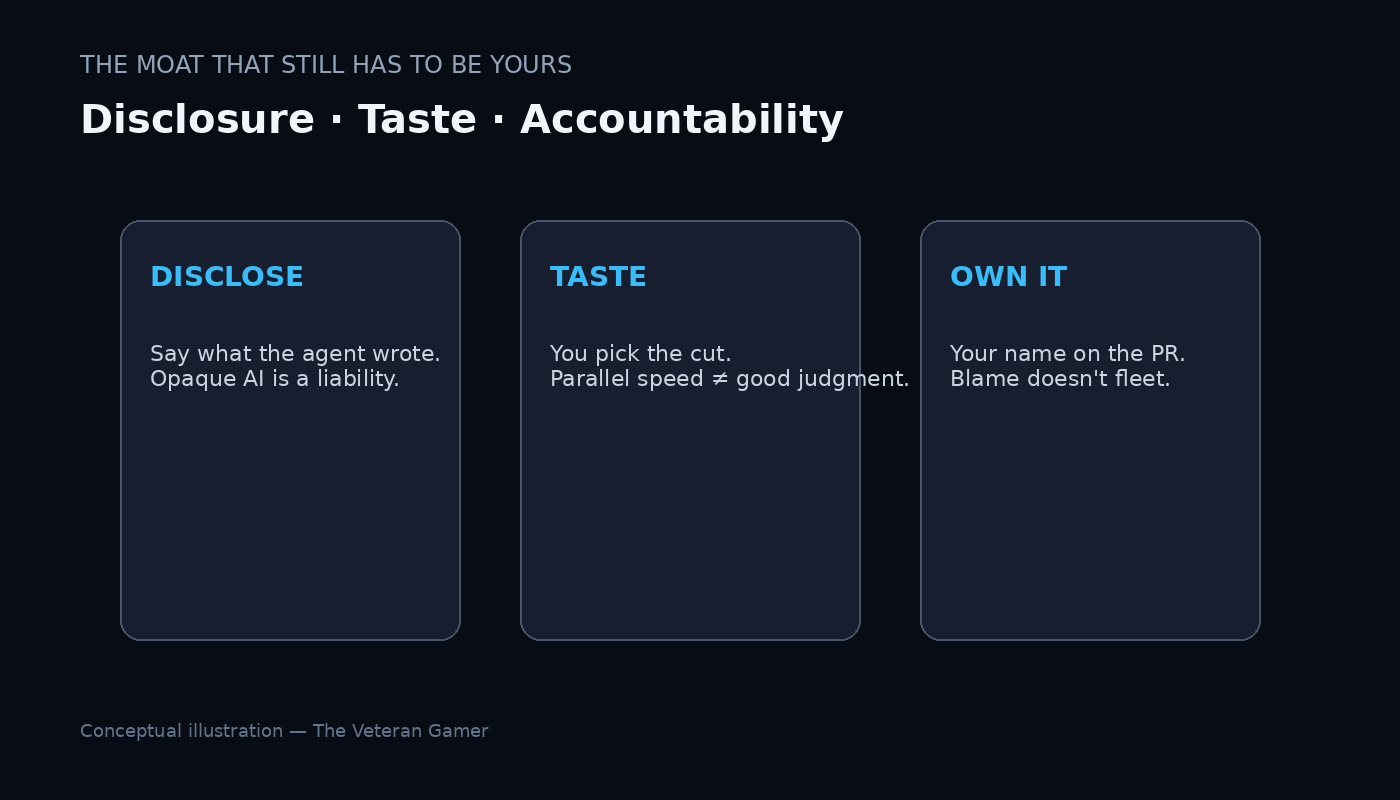
That is why authenticity is not soft branding talk. It is operational. Taste is choosing which of five agent options is actually good. Accountability is putting your name on the merge. Disclosure is refusing to launder agent work as pure human craft when it was not.
For daily agent users, a practical bar:
- You can explain the change — architecture, tradeoffs, and what you rejected.
- You can reverse it — or you know who can, and how fast.
- You can defend the claim — if you say “I built this,” the disclosure matches the labor split.
If you clear that bar, fleets make you dangerous in the good way. If you do not, fleets make you a high-throughput source of plausible mess.
A practical stance for builders who use agents every day
Skip the hype cycle. You do not need a manifesto. You need operating rules that survive a busy week.
1. Brief like a lead, review like a lead. Parallel agents reward clear intent and punish vague prompts at scale. Write the goal, constraints, and definition of done once. Redirect threads early. Kill sunk-cost threads without guilt.
2. Decompose for parallelism; serialize for taste. Let fleets chew independent work. Keep product voice, API shape, security boundaries, and “does this feel right?” in a human queue.
3. Socket with an allowlist. MCP (and friends) should expand capability on purpose. Start narrow: repo read, tests, docs. Widen only when the blast radius is understood.
4. Disclose by default in public work. A one-liner in a README, a changelog, or a video description beats a reputation hit later. Creators who hide the stack will lose to creators who show it and still ship better judgment.
5. Keep a human signature ritual. Before merge or publish: read the diff or the draft cold. If you cannot summarize it without the agent in the room, you are not ready to claim it.
None of this is anti-agent. It is pro-trust. Fleets amplify whoever is steering. If the steerer has taste and a spine, the fleet is leverage. If the steerer is collecting output like loot, the fleet is just a faster way to embarrass yourself in public.
What still has to be human
Short list, no mysticism:
- Taste — what “good” means for this product, this audience, this week.
- Priorities — what not to build, even though an agent could.
- Ethics and disclosure — what you owe the people who trust you.
- Accountability — who answers when it breaks or misleads.
- Relationships — the call, the cue, the “I see you” that no coordinator thread replaces.
Everything else is negotiable tooling. Claude Code Projects, Cursor MCPs, whatever ships next month — they will keep making the negotiable parts cheaper and faster. That is good. It does not retire the human list.
The Veteran Gamer take
Agent fleets are not coming. They relaunched on the calendar. MCP is not a buzzword if you use it as glue with rules. The remaining scarcity is authenticity: saying what the stack did, choosing what deserves to ship, and signing the result with a name that still means something when things go wrong.
If you build in public — or you just build — keep the socket sharp and the signature sharper.
More builder takes on the channel: YouTube @veterangamer217 (Veteran Gamer). Drafts and deeper cuts land here on theveterangamer.com.